Why We Use BTR Products for Metal Tile Roof Installations in Miami
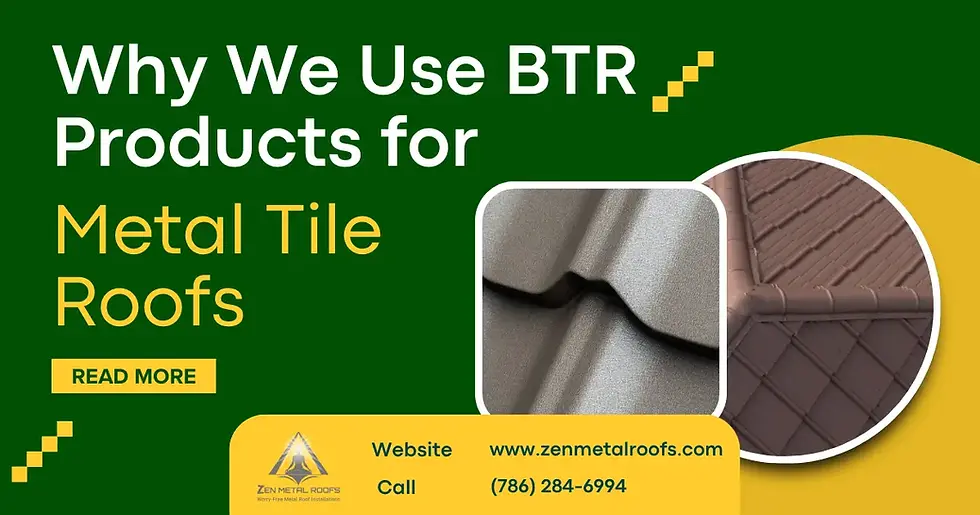
Miami homeowners love the timeless look of tile roofs, but South Florida weather doesn't always love traditional tile. At Zen Metal Roofs, we've built our metal tile roofing program around BTR Systems because their products deliver the curb appeal Miami neighborhoods demand with the engineering backbone South Florida weather requires.
If you're exploring a roof that captures Mediterranean elegance without the weight, cracking, and maintenance headaches of clay or concrete tile, this guide explains why we chose BTR as our metal tile partner and how our installation process transforms their engineered panels into roofs that protect your home and investment for decades.
What metal tile roofing really means in South Florida
Walk through Coral Gables, Pinecrest, or Miami Shores and you'll see Spanish tile everywhere—it's part of the architectural DNA of South Florida. But traditional clay and concrete tile bring serious challenges: they're heavy (often requiring structural reinforcement), they crack under impact, they absorb water during heavy rains, and they can lift or blow off in hurricanes if not properly secured.
Metal tile roofing bridges the gap. Modern metal tile systems use formed steel panels that replicate the dimensional curves, shadow lines, and texture of traditional barrel or S-tile—but the panels are a fraction of the weight, won't crack or absorb moisture, and when properly installed can handle the wind speeds and driving rain that define hurricane season in Miami-Dade, Broward, and Palm Beach counties.
We've watched homeowners struggle with cracked tile, water intrusion at tile laps, and insurance companies requiring expensive reinforcements or full replacements after storms. Metal tile solves those problems while keeping the look that makes South Florida homes feel timeless and high-end. Learn more about our approach to metal tile roof installation in Miami.
Who BTR Systems is and why we partnered with them?
BTR also offers up to 60-year manufacturer's warranty on certain products, which tells you they're confident that their materials and cNot all metal tile systems are created equal, and we learned that through trial and error, and by testing multiple manufacturers' products over the last 10 years. Some manufacturers focus only on the panel profile and leave installers to figure out flashing, edge details, and accessory compatibility on their own. Others offer beautiful panels but no real engineering support or warranty backing when things go sideways.
BTR Systems stood out because they're a family-owned company with nearly 50 years of experience in roofing systems, a strong presence in European markets, and a clear commitment to quality control and long-term durability. They partner with ThyssenKrupp Steel Europe for their steel supply, which signals they're serious about material consistency and traceability—critical when you're asking a roof to perform in salt air and under blazing UV for decades.
What really caught our attention was their systems approach: BTR doesn't just sell panels. They engineer complete roof systems with purpose-built accessories, detailed installation guidelines, and warranty programs that back the entire assembly—not just the metal itself. That's the kind of partner we need when we're putting our reputation on a Miami roof.
Coatings will hold up over the long haul. For homeowners, that warranty is a safety net and a guarantee for performance. For us as a metal roof installer, it means we're installing a product backed by a manufacturer who won't disappear when a customer needs support.

The BTR advantages that make installation faster and roofs stronger
Lightweight design that is engineered to put less load on your trusses and roof deck
One of the first questions Miami homeowners ask when they're considering a roof upgrade is: "Do I need to reinforce my structure?" With traditional tile, the answer is often yes—especially if you're switching from shingles to tile, because concrete or clay tile can add 8–12 pounds per square foot or more.
BTR's metal tile panels weigh approximately 8.8 pounds per panel. The way the system is designed, it distributes all the weight of the panels across the entire roof deck rather than concentrating weight on individual battens or purlins. This means most existing roof structures can handle the load without additional reinforcement. That's a huge money saver, and the best part is that your new roof installation can move forward without weeks of structural engineering and permitting delays.
For us, lighter panels also mean safer installation, easier material handling on job sites (especially multi-story homes), and less wear on our crews. It's a win across the board.
Modular panels that fit together with precision
BTR describes their metal tile system as interlocking panels that "fit together like a puzzle”. The design is intended to simplify and speed up installation, and this also helps our roofers align and secure the panels more efficiently. Modular systems with tight tolerances also reduce the chance of installer error, which protects both the homeowner and our reputation.
Why does that matter? Consistency is the difference between a roof that looks “fine” at a distance and one that looks excellent from every angle—even years later. This type of curb appeal can help protect resale value.
Zen Metal Roofs has installed enough roofs to know that when panels fight you during layout, something's wrong—either the product design has issues or the manufacturing tolerances are loose. BTR panels align cleanly, lock correctly, and create repeatable results across projects. That's the kind of quality control that makes our crew’s job easier and your roof better.
Dramatically less waste on every project
Here's a number that shocked us when we first heard it: BTR claims their steel roofing tiles average less than 5% waste during installation, compared to industry norms that can exceed 10%. We've validated that on our own projects—most BTR metal tile roofs generate far less scrap and cutoff waste than comparable systems.
Less waste means lower material costs (which we can pass along to homeowners), smaller dumpsters, cleaner job sites, and faster cleanup after installation. It also means we're not throwing away perfectly good steel because of poor design or excessive trimming requirements. For environmentally conscious homeowners, waste reduction is a meaningful benefit.
The materials and coatings that make BTR panels last in Miami's climate
Miami's coastal environment is brutal on building materials. You're dealing with year-round humidity, salt spray that drifts miles inland, UV radiation that's among the strongest in the continental U.S., and temperature swings that cause expansion and contraction cycles every single day. Roofs that look great in Colorado or Ohio can fail fast here if the materials and coatings aren't up to the challenge.
ThyssenKrupp Pladur® Winkle Mat Plus and ZM EcoProtect®
BTR manufactures its roof panels from steel supplied by ThyssenKrupp steelworks, a a well regarded brand known for its high quality standards and consistent production processes. But raw steel is only the starting point. The real protection comes from the coating system.

BTR applies a ZM EcoProtect® coating layer to the steel substrate, which is an advanced zinc-magnesium alloy coating designed for maximum corrosion resistance. On top of that, they add a 50-micron layer of Paldur Wrinkle Mat Plus, which is a durable, UV-stable finish coat that resists fading, chalking, and discoloration over time.
In practical terms, that coating stack does two things homeowners care about: it protects the steel from rust and corrosion (even at cut edges and fastener penetrations where the coating is compromised), and it keeps the color and finish looking fresh year after year. We've seen BTR roofs that are 10+ years old in coastal South Florida, and they still look sharp—no significant fading, no rust staining, no coating failure.
BTR also states their modular metal roofing tiles are engineered to withstand UV rays, hurricanes, and hail, which is exactly what is needed for Miami installations.
To learn more about how coating technology affects durability, check out the BTR Systems website.
Why a complete accessory system matters more than most homeowners realize
Here's something most people don't think about when they're shopping for a roof: the panels are only part of the story. What really determines whether a roof stays watertight and wind-resistant for up to 60 years is what happens at the edges, valleys, ridges, penetrations, and transitions—all the places where water wants to get in and wind wants to get under.
Many metal tile manufacturers offer beautiful panels but leave installers to figure out edge trim, valley flashing, ridge caps, and penetration boots on their own. That usually means cutting and bending generic trim pieces on site, which takes time, creates weak points, and produces inconsistent results.
BTR offers a full line of specialty steel roofing accessories designed specifically for their metal tile systems, including fascia edge pieces, corner fittings, drip edge profiles, and color-matched finishing screws. Every accessory is engineered to work with the panel profile, coated with the same finish system, and designed to install quickly and cleanly.
For us, that accessory ecosystem is a game-changer. It means we can build details that look factory-finished rather than field-fabricated. It means fewer on-site cuts and bends, which reduces labor time and improves consistency. And it means we're creating a complete system where every component is designed to work together.
When a hurricane rolls through and your neighbor's roof loses a ridge cap or has flashing peel back, you'll understand why we're so focused on details. A roof is only as strong as its weakest connection, and BTR's accessory system helps us eliminate weak connections.
How we install BTR metal tile roofs in South Florida
Great materials are necessary but not sufficient. Installation quality matters immensely and is the multiplier that turns good components into a roof system you can trust. At Zen Metal Roofs, we've developed a disciplined process for BTR metal tile installations based on Miami-Dade building codes, manufacturer guidelines, and nearly two decades of hands-on roofing experience in South Florida.
Our team and our training
Our approach is led by Eduardo Garcia, co-founder of Zen Construction Group, who brings 10+ years of construction and roofing knowledge. Eduardo's understanding of Miami-Dade roofing code compliance, paired with his commitment to delivering a quality install on each and every home matters when you're installing a roof designed to survive Category 5 hurricanes.
Zen Metal Roofs are certified installers for BTR metal tile systems, which means we've completed manufacturer training on proper handling, layout, fastening, and finishing techniques specific to BTR panels and accessories. That training matters because metal tile systems have unique installation requirements, such as panel overlap sequences, fastener placement patterns, expansion allowances, and edge detailing that differ from standing seam or other metal roof types.
If you'd like to learn more about our team and our commitment to quality, visit our About Us page.
What happens during a BTR metal tile installation
Every project starts with a thorough roof inspection and structural assessment. We verify the deck is sound, check for any soft spots or deterioration, and confirm the roof geometry and slope meet the requirements for BTR metal tile (most systems require a minimum pitch, typically 3:12 or steeper).
Next, we prepare the deck with high-performance synthetic underlayment (not the basic felt with a 15-20 year life span), but engineered underlayment designed to resist UV, high temperatures, and water intrusion if a panel ever fails or gets damaged. That underlayment is your first line of defense, and we don't cut corners on it.
Then comes panel layout. We measure carefully, plan panel runs to minimize waste and create clean sight lines, and mark fastener locations based on engineering requirements and wind-load calculations for your specific project. In high-wind zones (which includes most of Miami-Dade and Broward counties), fastener spacing and edge attachment are critical. Missing a fastener or using the wrong screw type can compromise the entire roof's wind resistance.
We install BTR panels starting from the eave and working toward the ridge, ensuring each panel locks properly with the previous panel and is correctly interlocked. Fasteners go exactly where they're supposed to go. Not "close enough," but exactly in the correct position, because that's what is required for your warranty.
Finally, we install all the trim, flashing, and accessory components: drip edge at the eaves, rake trim at the gable ends, valley flashings where roof planes meet, ridge caps at the peak, and custom flashing at penetrations like vent pipes and HVAC equipment. Every piece gets sealed, fastened, and finished to create a continuous weather barrier.
Our goal is simple: when we're done, your roof should look beautiful, perform flawlessly, and meet or exceed Miami-Dade hurricane building code requirements. We walk every completed project with the homeowner, explain what we did and why, and provide all the documentation you need for permits, inspections, and warranty registration.
Helping Miami homeowners get the "tile look" that fits their neighborhood
One of the most common questions we hear is: "Will this actually look like tile, or will it look like metal trying to look like tile?" It's a fair concern because curb appeal matters, and many Miami and South Florida neighborhoods have strict HOA guidelines or historic preservation standards.
BTR metal tile systems are designed specifically to replicate the dimensional profile, shadow lines, and texture of traditional clay or concrete tile. The panels have the same curves and reveals you'd see on a Spanish S-tile or barrel tile roof. When installed correctly with color-matched fasteners and trim, the finished roof looks like Spanish tile from the street, from neighboring properties, and even from close inspection.


We help homeowners choose BTR panel profiles and colors that match their home's architectural style. Samples brought to you to show you how the panels look in real sunlight against your siding and trim, and walk you through color options and finish choices.
If you're dealing with HOA architectural review, we can provide product specs, finish details, and sample submittals to streamline the approval process. Eduardo and our team have extensive experience helping Miami homeowners navigate HOA requirements and get approvals quickly.
If you're curious about how metal tile compares to other metal roofing options, you might also want to read about Standing Seam as another steel roof option learn about costs and benefits of the different systems.
Cost, value, and financing: making a smart roof investment
A metal tile roof is a significant investment that offers real long-term value. While it is not the most inexpensive roofing option upfront, it’s long life saves you money over the longterm. Factor in maintenance for tile or asphalt, energy efficiency, and storm protection, and you can see that a metal tile roof delivers real value that traditional tile and asphalt shingles simply can't match.
Traditional clay or concrete tile might last 20–30 years in South Florida (less if you're near the coast and experience frequent storms), but your true costs go up as you spend money on repairs, re-bedding, and periodic cleaning and maintenance throughout that lifespan.
Asphalt shingles in Miami typically need replacement every 15–20 years because of UV degradation and wind damage, and they offer minimal energy-efficiency benefits.
BTR metal tile roofs are engineered to last 40–60 years with minimal maintenance. The coating system resists fading and corrosion, the panels won't crack or chip, and the lightweight design means less stress on your home's structure. The reflective properties of metal also help reduce attic temperatures and improve energy efficiency. You see a saving in electricity.
We also emphasize transparency throughout the process. We take the time to explain your options, walk you through the cost breakdown (materials, labor, accessories, permits, engineering if required), and help you understand what you're getting for your investment. Our goal is to help you make a decision that fits both your aesthetic goals and your long-term financial planning.
Ready to get a quote for BTR metal tile for your Miami home?
We serve homeowners throughout Miami-Dade, Broward, and Palm Beach counties, and we focus on building roofs that protect your home through hurricanes, salt air, and Florida heat while enhancing curb appeal and long-term property value.
Get a quote today for your metal roof project.


